A Nightcap

Written the other night as I relaxed before bed.

冷酒啜り世界忘れてしばしかな
reishu susuri sekai wasurete shibashi kana[1]

sipping sake
while I try to forget the world
for a while

Sake set, by Epopt
Sake set, by Epopt

’m not a big drinker, but I do enjoy sake sometimes (usually called nihonshu 日本酒 in Japanese). If you’ve never tried it before, it has a wonderful smooth taste. Not as strong in effect as whisky, nor as strong in taste as red wine; a little stronger than beer, but smoother, with some hints of fruitiness which is always very mysterious to me given it comes from wine. That’s something the koji adds, I suppose? (koji is the mold used to ferment the drink). It is usually translated as “rice wine”, but since rice is a grain it’s more of a beer than a wine. But the taste is more similar to a wine. All around great drink.

Whatever the case many be, it’s a delightful drink. If you’ve never tried it before, see if you have a Japanese grocery nearby and if so go buy some. I’m not an expert, so I don’t know well all the different types. My friend who is an expert told me to look for junmai daiginjo (純米大吟醸) or daijinjo (大吟醸), so those are what I always get. You might look for that too if you have a chance. But even the cheap stuff is usually pretty good. When I buy it I look for the good quality kinds that my friend suggested, but when my wife buys it for me she often buys these big 2 or 3 liter cartons that are only something like ¥1000. Cheap stuff, in other words. But even that is pretty good, so I have no complaint.

Although you may have read that some places serve it hot, it is best cold, so I’d suggest that.

I wrote the above haiku when I was having a cup at the end of the day. That particular day had been a little busy. Not bad, just busy and hectic so I was worn out. I always try to leave work at work and clear my mind of things. My zazen (Zen style meditation) helps with that and has conditioned my mind enough that I’m pretty good at leaving the world behind and living in the moment. That said, the sake does help with that, loosening my thinking just enough to allow the stress of the day to more easily slip away.

Like many many Japanese men say, I look forward to when my sons are of age so I can drink with them.

You may be surprised that sake is a kigo (season word). There are actually many kigo for sake of all different seasons. Reishu or hiyazake, words for “cold sake” would have been used back in the day instead of nihonshu. All three can be used as summer kigo. According to the traditional Japanese almanac which haiku follows, we just started summer a few days ago, making the summer kigo apt.

Moonlight & Wisteria

The other day I posted some photos of the wisteria on a different blog. Around 300 years ago, someone else was thinking of those pretty flowers. He wrote:

月に遠くおぼゆる藤の色香かな
tsuki ni tōku oboyuru fuji no iroka kana[1]

in the moonlight
the scent and color of the wisteria
seem far away
—Buson[2]

Wisteria at Tsushima by David LaSpina
“Wisteria at Tsushima” by David LaSpina

Is “wisteria” also the plural form? “Wisterias” sounds strange to me, but I could just be under the influence of Japanese here which would not change form. As you can see in the photo above, the wisteria bloom in pretty big patches so I’d tend to use the word with a plural meaning.

Anyway, Buson is generally considered one of the top haiku masters in history, probably second only to Bashō. He was a painter in addition to a poet and in fact made his living primarily from his painting, at least when he was younger. Due to this, most of his haiku have an artistic quality, as if he were painting with words. This arguably makes his style more influential than the great Bashō. A hundred and fifty years later when Shiki created the modern haiku it was from Buson that he took influence, not from Bashō whom he considered overrated. And today, at least when people aren’t playing simple syllable counting games, the majority of haiku people write follow this “painting with words” approach. Shiki called this shasei by the way.

There is a wonderful ambiguity in this haiku above. Is he talking of a real distance or an imagined one? If he talking of the here and now or is he wistfully thinks of the past? The wisteria already have an ephemeral quality as they only last a short time; both the setting of night and the ambiguity of the poem emphasize this. As so often with Buson, there is a sense of tranquility here, an atmosphere of contemplation. There is a strong feeling of mono no aware, which is seeking beauty and meaning in the fleeting moments of life.

The kigo (season word) here would be fuji (“wisteria”). It is a kigo for late spring.

Dreaming of Turtles

はつ夢や正しく去年の放し亀
hatsuyume ya masashiku kozo no hanashi-game[1]

first dream
it was last year’s
freed turtle
—Gonsui[2]

Turtles and Sake Cup by Yashima Gakutei
“Turtles and Sake Cup” by Yashima Gakutei

The New Year in Japan brings a collection of firsts that people enjoy doing. Of these, first dream and first sunrise may be the most popular.

This haiku looks at one of those firsts: the first dream of the year. Gonsui’s dream of turtles would be a very auspicious dream—a dream of turtles he set free in the previous year, doubly so.

Liberating animals once or twice a year is an old Buddhist practice, and that is what Gonsui is referring to here. Turtles are a very special creature in Japan. In mythology the turtle is associated with long life—1000 years, they say—and it is also a very thankful creature, always returning any kindness shown to it. One may be reminded of the folk tale Urashima Taro in which as a reward for saving him the turtle rewards Urashima by taking him to the kingdom at the bottom of the sea.

In olden times fishermen would throw back any turtles they caught, but not before treating them to a bit of saké. No doubt they hoped the turtle would be thankful and would come back to reward them.

In Gonsui’s dream, was the turtle (or turtles) he released showing up to express gratitude and perhaps give a gift of long life? I’m sure Gonsui hoped so!

A New Years Resolution

It’s now been almost three years since I bought this domain and set up this page. I had big plans. But I was a perfectionist. I wanted every post to be perfect. I wrote plenty of material about Japan and about haiku, but I never actually posted most of it because it wasn’t perfect. As a result, this site has laid fallow for far too long.

I actually have still been writing for the internet. I’ve been writing and posting every day over at Hive. Here. I do earn money there, but not much—only about $5-$10 per post, and it’s paid in crypto, making it a pain to withdraw to either dollars or yen—so that is hardly a draw. For whatever reason posting there has not triggered my perfectionism in the same way that this blog has, as a result I actually post what I write there instead of sitting on it until it’s perfect. Perhaps it’s because I have no control over formatting there, whereas on this blog I have complete control; complete control can be good, but it can also be crippling because we want to use that control to make everything perfect.

Whatever the case may be, going forward I intend to push past this perfectionism and start publishing here again, ideally often. At first I may just continue my habit of publishing daily on Hive and then copy that post to here, but eventually I would like to reverse that, instead writing the post for this site and then copying it to Hive.

I don’t think I have comments turned on on this site. And I know the internet loves comments, so I’ll get on that. In the meantime, I will be using Twitter (until Elon kills it) and Mastodon. I’ll work out a footer with links to both of those. It’s been so long since I designed this site that I don’t remember offhand where to put the code for a footer. Please bear with me as I rediscover WordPress and the theme that I designed.

If I don’t make another post today (and if anyone discovers this), have a happy new year! May 2023 be a better one for us.

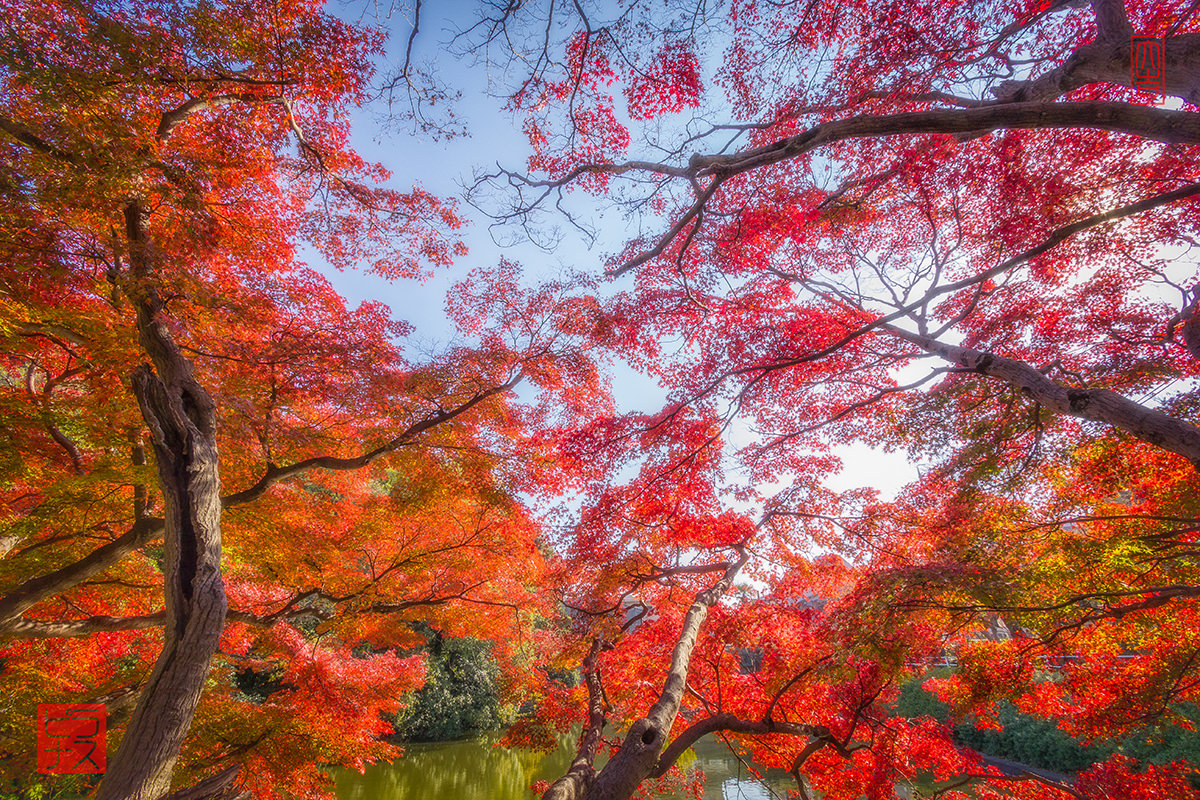
Our Secret Meeting Place

Under the spreading maple trees.

The bright red Japanese maples (紅葉 momiji) are without compare. Of all the autumn colors, they stand out the most. They go best when contrasted with the brilliant golden ginkgo (銀杏1, ichō), but are still gorgeous by themselves.

For the Japanese poetry lovers among us, momiji by itself is a kigo for late autumn. My saijiki2 mentions that momiji viewing parties began in the Heian period, which incidentally is also when cherry blossom viewing parties stared to be a thing.

This photo from Rokusho Shrine, which I previously introduced. There is a high school nearby, so school-kids are constantly going through this area. Not much of a secret place, unfortunately, but a beautiful one.


  1. Usually written with katakana instead of kanji: イチョウ. Easier to write that way, though much less interesting to kanji lovers like myself.  ↩

  2. A saijiki is a book or books (sometimes several volumes long) that contains a listing of kigo—season words—for use in haiku, divided by season, along with example haiku for each word and brief description.  ↩

There is more in the archives